From Builder to Operator
From Builder to Operator
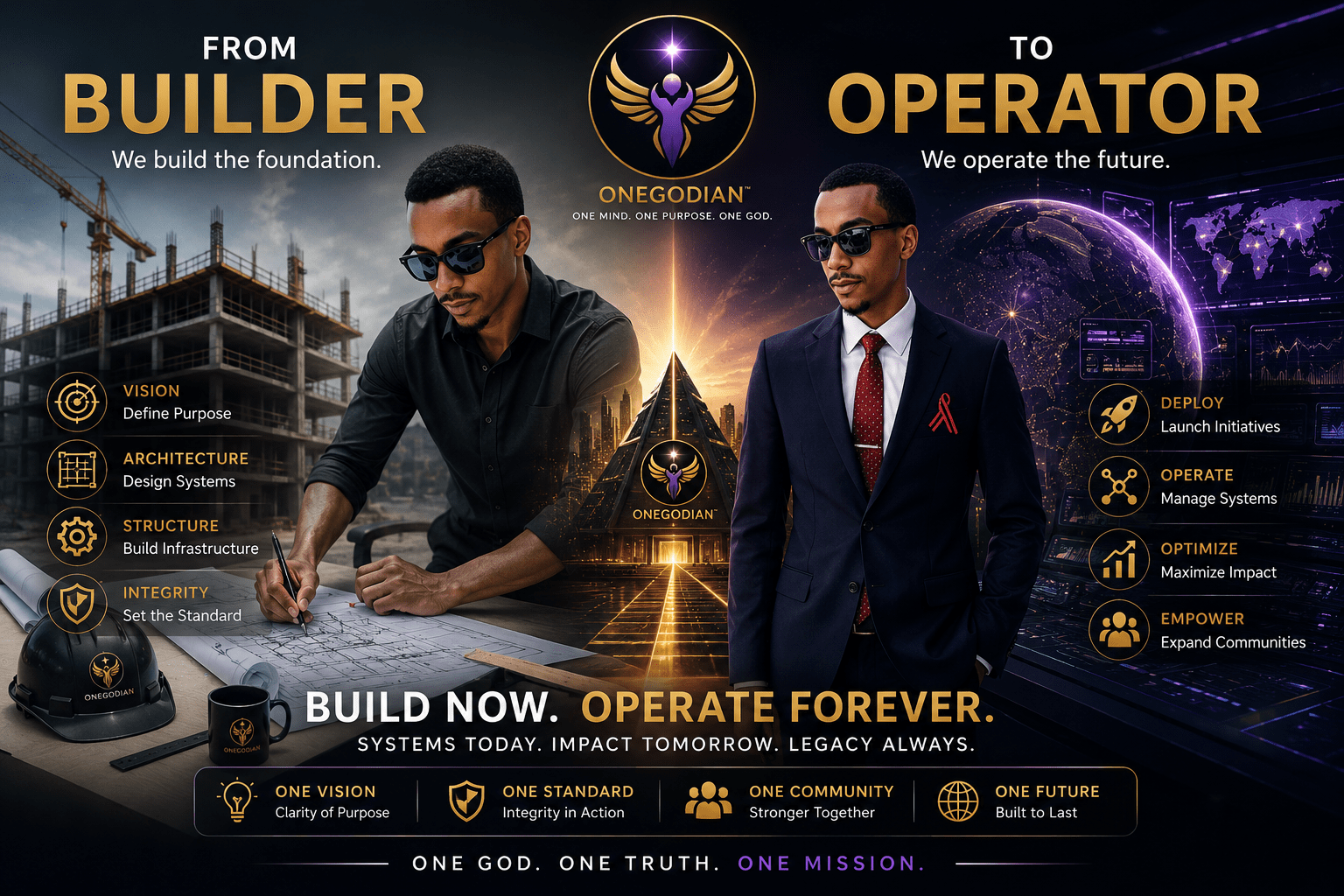
There’s a major difference between building something and operating it.
A builder creates systems, ideas, infrastructure, frameworks, brands, products, and architecture.
An operator makes those systems function in the real world—daily, consistently, under pressure, with accountability attached to every decision.
For years, I was primarily in builder mode.
I was creating:
- platforms
- systems
- frameworks
- identity structures
- educational architecture
- digital infrastructure
- documentation
- operational models
- governance concepts
- technology positioning
- long-term ecosystem design
A large part of that work was invisible.
Most people only see the public-facing layer after the systems already exist. They do not see the years spent organizing concepts, refining language, correcting structure, studying operational realities, testing models, rebuilding architecture, and learning how institutions actually function.
The shift happened when I realized something important:
A system that cannot operate consistently in reality is incomplete.
That changed how I approached everything.
Instead of only asking:
- “Can this be created?”
I began asking:
- “Can this be maintained?”
- “Can this scale?”
- “Can this survive pressure?”
- “Can this function legally?”
- “Can this operate financially?”
- “Can this support people consistently?”
- “Can this integrate with existing systems?”
- “Can this become infrastructure instead of just an idea?”
That is the transition from builder to operator.
Builders think in possibilities.
Operators think in execution, continuity, systems, timing, compliance, resources, leverage, and sustainability.
Today, much of my focus is operational:
- structuring platforms correctly
- separating public and execution domains
- building stable infrastructure
- refining governance layers
- creating monetization systems
- aligning branding with legal clarity
- organizing databases and records
- improving deployment architecture
- creating scalable user pathways
- preparing systems for institutional interaction
This shift also changed how I think personally.
Operating requires:
- emotional discipline
- strategic patience
- controlled communication
- long-term planning
- financial realism
- risk management
- system thinking
- consistency under uncertainty
The goal is no longer simply to build impressive concepts.
The goal is to create operational systems that can:
- function repeatedly
- support growth
- withstand scrutiny
- evolve over time
- remain coherent across platforms and environments
That mindset is reflected throughout the current Onegodian ecosystem architecture, where infrastructure, governance, digital identity systems, platform organization, and execution layers are increasingly being separated and clarified for operational stability.
It also aligns with the broader transition from conceptual frameworks into implementation systems, APIs, governance layers, and operational protocols described in the Onegodian Algorithm documentation.
Even the evolution of the Onegodian Timekeeping System™ reflects this operational shift—moving from symbolic structure toward deterministic, production-safe standards focused on auditability, consistency, and interoperability.
And internally, this evolution mirrors the operational discipline framework documented in the Founder & CEO Perspective:
- control of mind
- control of communication
- strategic execution
- financial architecture
- systems-based thinking
- long-horizon development
Building creates vision.
Operating turns vision into reality.