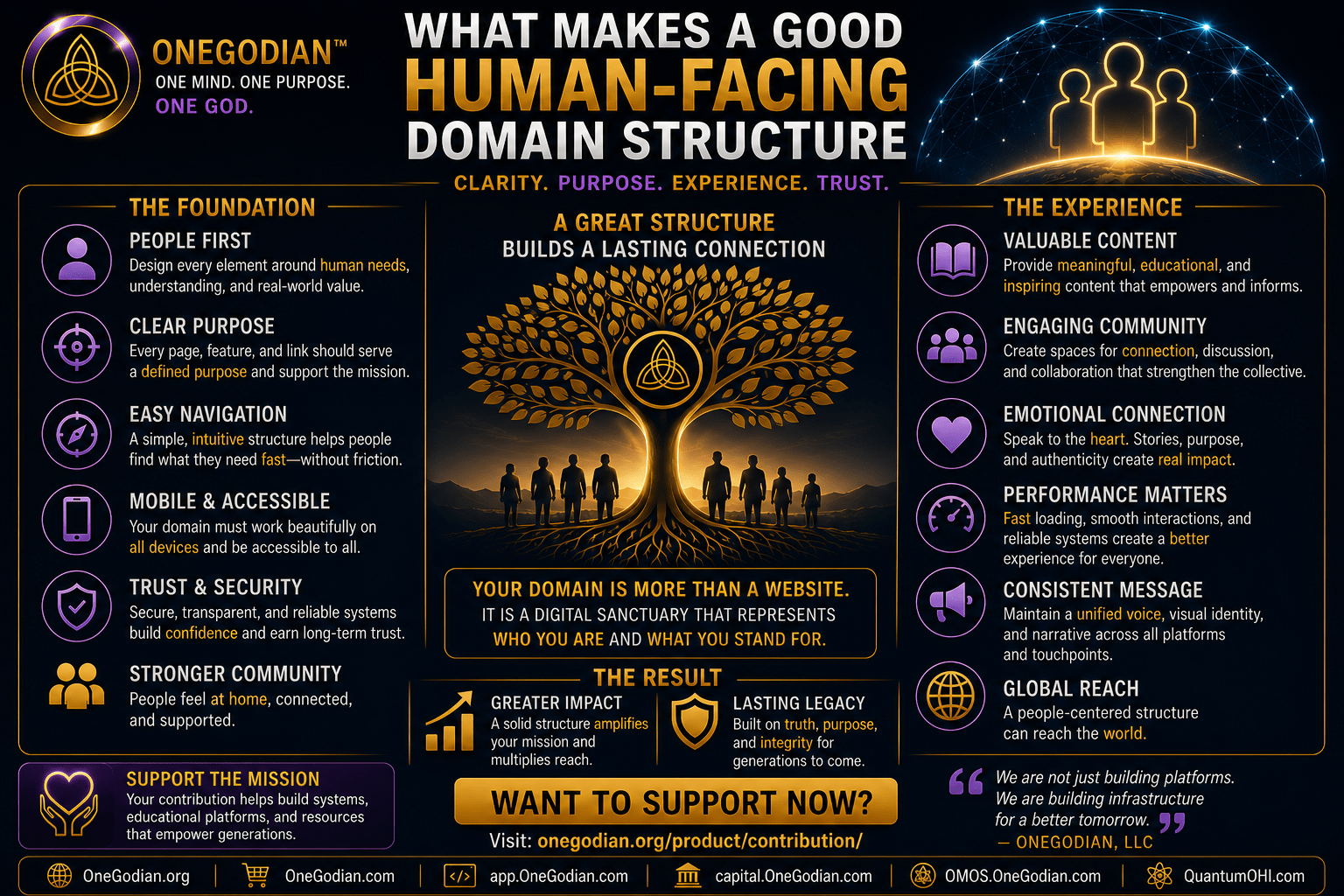
What Makes a Good Human-Facing Domain Structure
Published Record
The Second Day™ — Teyó·ra
Genesis 20, 0001 OT
Gregorian Sync
Monday, April 6, 2026
What Makes a Good Human-Facing Domain Structure
This post is part of the onegodian.org/ editorial sequence and is written for a civil, cultural, and human-facing environment where language, structure, and public interpretation matter.
A good human-facing domain structure should clearly communicate:
• identity,
• thought,
• education,
• chronology,
• public explanation,
• and institutional continuity
without creating confusion between public interpretation systems and operational execution systems.
The purpose of a domain like onegodian.org/ is not simply to host pages.
It is to organize meaning.
That means:
• navigation should be understandable,
• terminology should remain disciplined,
• public-facing systems should stay accessible,
• and content architecture should reinforce clarity instead of fragmentation.
Why This Matters
Clarity of language protects:
• institutional credibility,
• public understanding,
• long-term documentation integrity,
• and cross-platform consistency.
It also reduces:
• category confusion,
• interpretive drift,
• infrastructure duplication,
• and unnecessary complexity.
Human-facing domains should explain systems clearly without overcomplicating them.
Recommended Public-Facing Focus Areas
• philosophy & thought leadership
• educational materials
• archives & chronology
• public explanation systems
• historical continuity
• cultural & community narratives
• structured documentation
• institutional clarity
A strong public-facing architecture creates:
• trust,
• readability,
• discoverability,
• and sustainable long-term growth.
Call to Action
Explore the related pages, review the current architecture, and follow the ongoing publishing sequence as onegodian.org/ continues expanding its public-facing systems and documentation layers.
#Onegodian #DigitalInfrastructure #PublicArchitecture #DomainStrategy #HumanCenteredSystems #InstitutionalClarity #KnowledgeSystems #EditorialSystems #OnegodianOrg