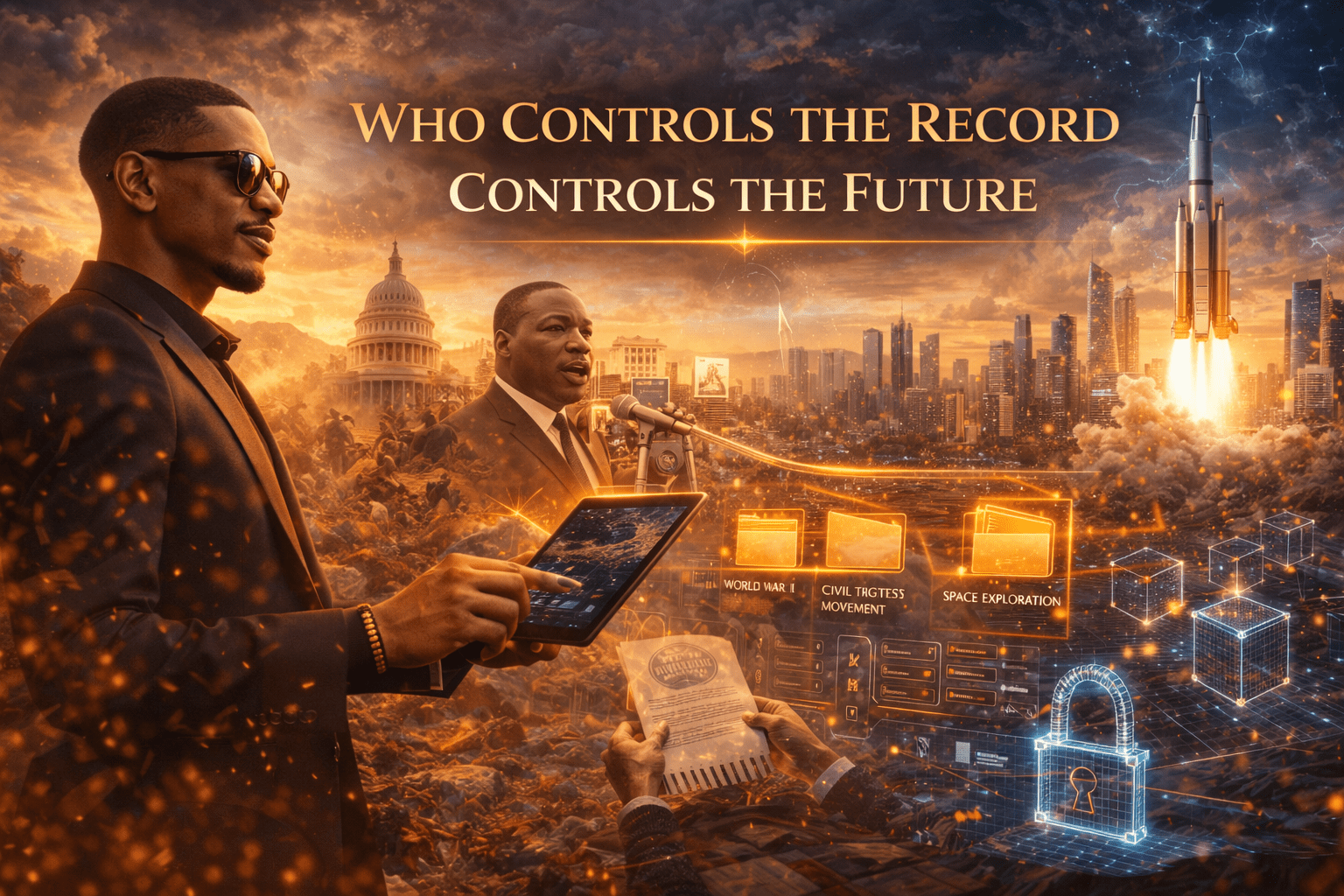
Who Controls the Record Controls the Future
Overview
Control of the historical record is not a passive function—it is an active system of power. The entity, institution, or individual that determines what is recorded, preserved, verified, and distributed ultimately shapes how reality is understood across time.
This is not theoretical. It is structural.
History is not only what occurred. It is what was documented, accepted, and made accessible.
1. The Nature of the Record
A “record” is not limited to written history. It includes:
- Legal filings and court records
- Land titles and ownership documentation
- Government archives and institutional reports
- Media coverage and public narratives
- Digital databases and search-indexed content
Each of these forms contributes to what becomes recognized as “truth” within systems of governance, finance, and education.
If an event is not recorded, it becomes difficult to prove.
If it is recorded inaccurately, it becomes difficult to correct.
2. Control Mechanisms
Control of the record occurs through several identifiable mechanisms:
A. Creation Control
Who has the authority to create official documents, reports, or filings.
B. Preservation Control
Which records are archived, maintained, or allowed to degrade or disappear.
C. Access Control
Who is permitted to view, retrieve, or distribute records.
D. Interpretation Control
How records are explained, taught, or framed within institutions.
E. Verification Control
What systems are used to determine authenticity and validity.
These five layers form a complete control model over historical and public memory.
3. Institutional Impact
Control of records directly affects:
- Property Rights – Ownership depends on recognized documentation
- Identity – Citizenship, membership, and legal identity are record-based
- Governance – Laws and authority rely on recorded precedent
- Economics – Financial systems depend on verifiable records
- Education – Curricula are built from accepted historical documentation
Without recognized records, participation in institutional systems becomes limited or denied.
4. The Transition to Digital Records
Modern systems have shifted control from physical archives to digital infrastructure:
- Search engines determine visibility
- Platforms determine distribution
- Databases determine persistence
- Algorithms influence interpretation
This introduces a new layer of control: infrastructure ownership.
Control is no longer only about what is written—it is about what is indexed, surfaced, and retrievable.
5. Risks of Centralized Record Control
When record control is centralized:
- Narratives can be selectively emphasized or suppressed
- Historical continuity can be fragmented
- Verification can become dependent on a single authority
- Access can be restricted or altered over time
This creates systemic risk in governance, law, and public trust.
6. Principles for Responsible Record Control
To maintain integrity, a record system should include:
- Transparency – Clear origin and authorship of records
- Redundancy – Multiple storage and archival points
- Verifiability – Independent methods of authentication
- Accessibility – Defined, fair access protocols
- Immutability (where appropriate) – Protection against unauthorized alteration
These principles are foundational for any credible historical or institutional framework.
7. Strategic Conclusion
Control of the record is control of:
- Narrative
- Legitimacy
- Authority
- Memory
- Continuity
Future generations will not experience events directly. They will rely on records.
Therefore, whoever controls those records effectively determines:
- What is remembered
- What is recognized
- What is enforceable
- What is forgotten
Final Position
The question is not whether records matter.
The question is:
Who is creating them, who is maintaining them, and under what system are they verified?
Because once a record is accepted into institutional reality, it becomes the foundation upon which the future is built.
There are no comments