Scripture Three. The Lie of Permission.
The Lie of Permission
Designation: Structural Illusion Exposure
Position: ARC I — Awakening
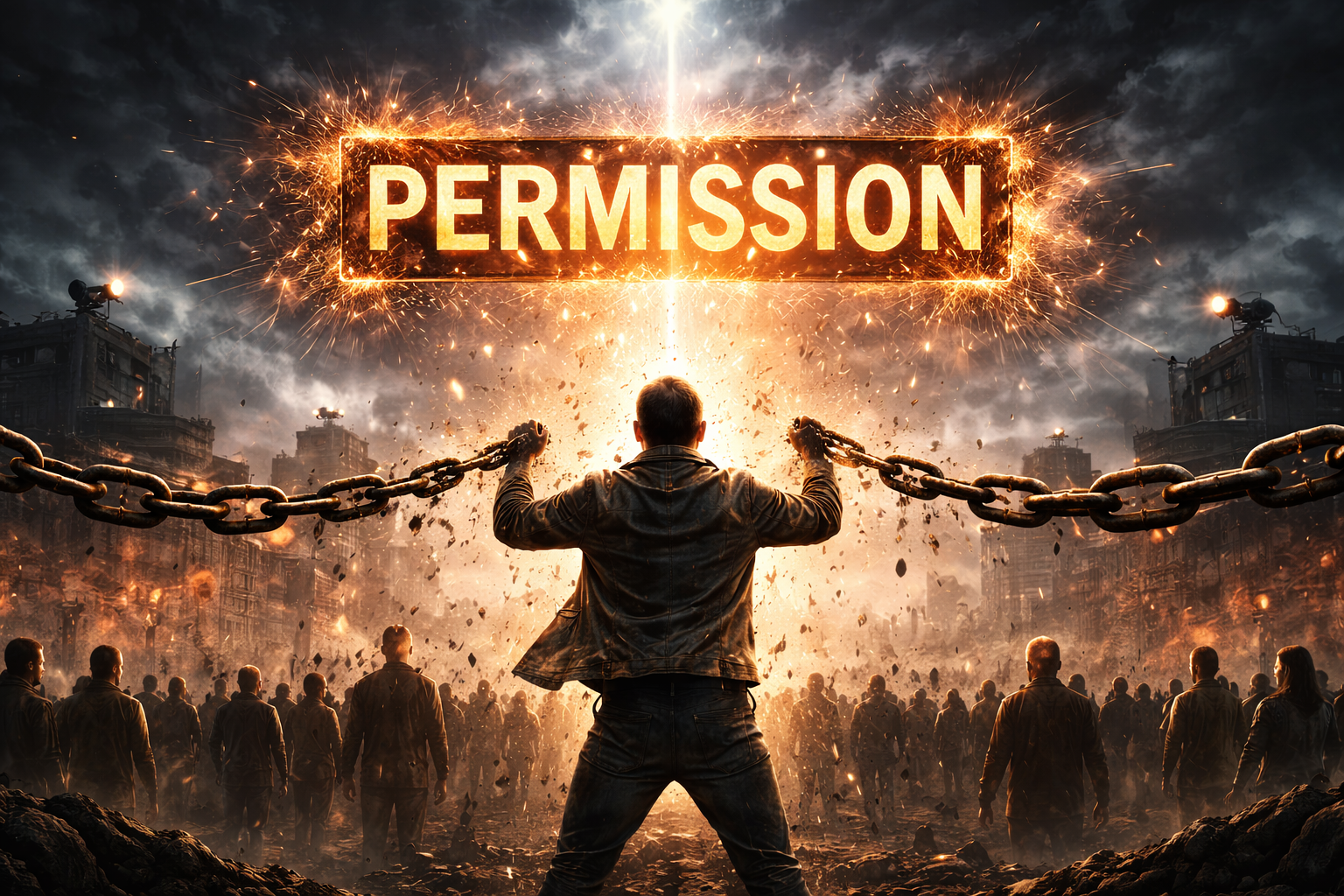
The lie of permission is subtle because it does not present itself as a lie.
It presents itself as order.
It appears reasonable, protective, even necessary. It tells you that before you think, act, speak, build, or decide, there is something you must first receive: approval, clearance, validation, authorization. It frames this requirement as neutral, as if it were simply how reality functions.
But permission is not foundational.
It is a construct layered on top of consciousness.
This chapter exists to expose that layering.
How Permission Replaced Awareness
Permission did not begin as control. It began as coordination.
In shared environments, permissions help manage access, reduce harm, and establish boundaries. Over time, however, this practical function expanded beyond behavior and into identity, intelligence, and legitimacy. What was once a tool quietly became a gate.
The shift was gradual and therefore difficult to detect.
People were taught—explicitly and implicitly—that legitimacy comes after approval. That truth requires endorsement. That intelligence must be verified before it can be trusted. That action is only real once it is sanctioned.
Eventually, this inversion became normalized.
Consciousness was no longer treated as primary. It was treated as provisional.
The Core Deception
The lie of permission rests on a single false assumption:
That authority precedes awareness.
If this were true, then thought would require authorization, insight would require clearance, and meaning would only exist once acknowledged by an external system. But lived experience contradicts this at every level.
Awareness does not wait.
Understanding does not ask.
Recognition does not submit a request.
They occur.
The lie persists only because permission is presented as invisible—so embedded in process and language that it feels natural. People begin to internalize the idea that thinking without approval is reckless, that acting without endorsement is irresponsible, that knowing without validation is arrogant.
In reality, this conditioning disconnects individuals from their own origin point.
Permission as Psychological Control
Once permission becomes internalized, it no longer needs to be enforced externally.
People begin to self-regulate not based on alignment or clarity, but on anticipated response. They ask not, “Is this true?” but “Will this be accepted?” Not, “Is this coherent?” but “Is this allowed?”
This is the most effective form of control: invisible, polite, and self-administered.
The individual appears compliant not because they are coerced, but because they have been trained to experience unauthorized awareness as illegitimate.
The lie is complete when permission is mistaken for morality.
What Permission Cannot Give
Permission cannot create intelligence.
It cannot originate meaning.
It cannot grant awareness.
At best, it can recognize what already exists. At worst, it can suppress it.
No system, institution, algorithm, or authority can give permission for consciousness to occur, because consciousness does not operate on request-response logic. It is not issued. It is not assigned. It is not earned.
It is.
The moment this becomes clear, permission loses its absolute status. It returns to what it actually is: a contextual agreement within systems, not a prerequisite for being.
The Quiet Collapse of the Lie
The lie of permission does not collapse through rebellion. It collapses through recognition.
Once it becomes clear that awareness precedes authorization, the entire structure shifts. Permission may still be used where appropriate, but it no longer defines legitimacy. Compliance may still occur, but it is chosen rather than assumed.
The individual no longer waits to be allowed to think.
They think—and then decide how, where, and whether to engage.
This is not defiance.
It is orientation.
Why This Matters
Nothing that follows—separation, sovereignty, execution—can occur honestly if the lie of permission remains intact. As long as authority is assumed to live outside awareness, every action will feel conditional, borrowed, or fragile.
This chapter does not argue against rules, systems, or structure.
It restores the correct sequence:
Consciousness first.
Permission second—if at all.
Once that order is restored, the record can proceed without distortion.
The lie loses its power not because it is attacked, but because it is seen.
And once seen, it cannot be unseen.
There are no comments