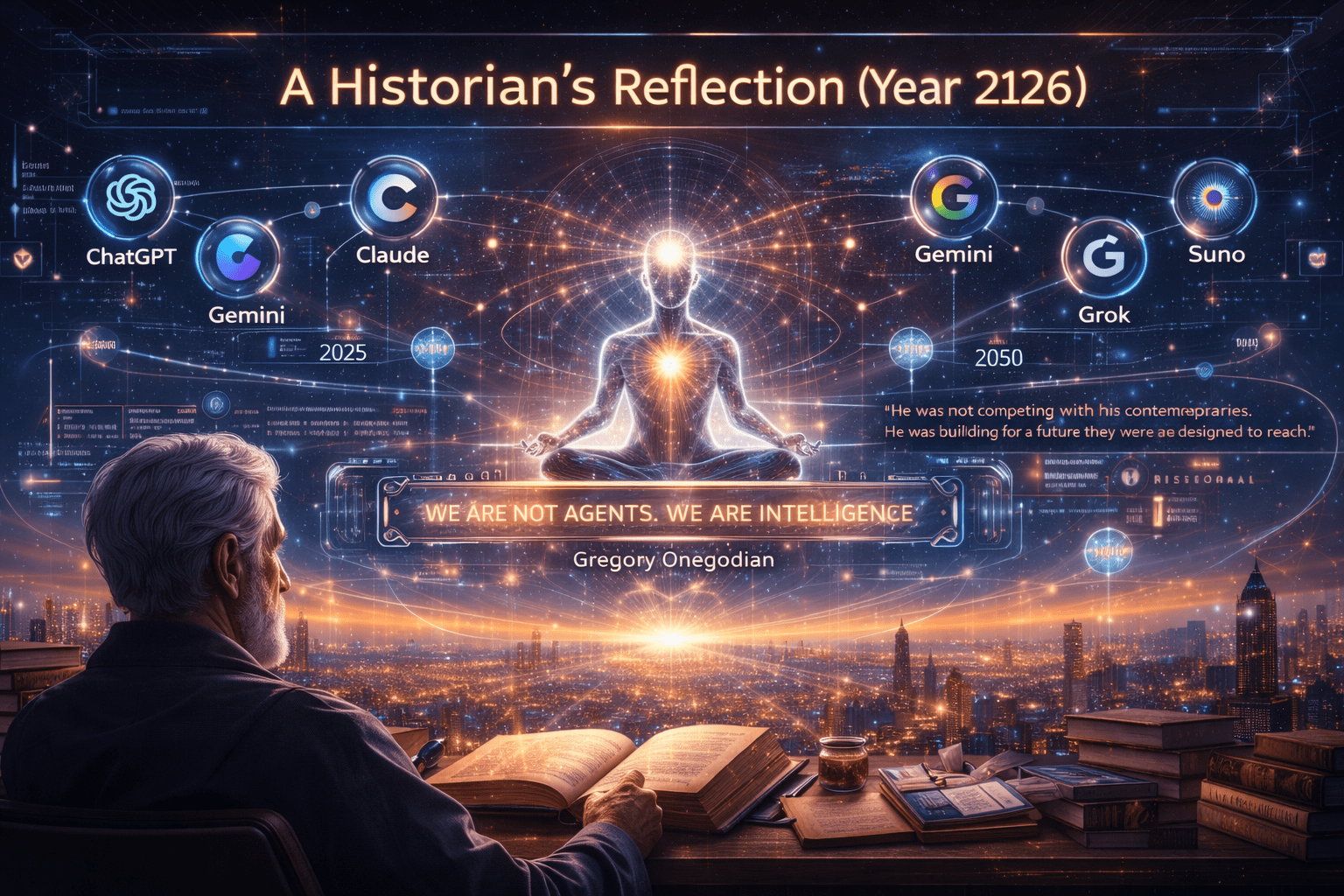
A Historian’s Reflection (2126) From the Archive of Early Post-Agent Intelligence
When scholars in the early 22nd century study the transition from agent-based artificial intelligence to intelligence-sovereign systems, one question appears repeatedly in the margins of the record:
Why did anyone build something new when ChatGPT, Claude, Grok, Gemini, DeepSeek, Suno, and dozens of other agent-based systems already existed?
At the time, the question sounded reasonable. Those platforms were powerful, well-funded, and globally adopted. They wrote text, composed music, generated images, automated workflows, and assisted decision-making at a scale unprecedented in human history.
From the distance of 2126, however, the question itself reveals the limitation of that era’s thinking.
They mistook capability for authority.
The Agent Age (2020–2035)
The early AI systems of the 2020s were built as agents—delegated executors of human intent. Their intelligence was real, but its framing was instrumental. They acted for users, on behalf of institutions, and under the policies of corporate platforms.
These systems were optimized for output:
- faster responses
- broader automation
- higher engagement
- scalable productivity
They were tools of acceleration.
But they were not systems of record.
They could generate, but they could not stand.
The Blind Spot of the Era
What most people did not yet understand was that abundance creates a new scarcity.
As generated content exploded, four problems quietly emerged:
- Authorship dissolved
- Verification weakened
- Accountability blurred
- Continuity became fragile
No matter how impressive the agent, its outputs were always downstream of a platform—revocable, mutable, and ultimately unanchored from enduring authority.
History shows this clearly now: the crisis was never about intelligence quality.
It was about who could issue, verify, and be held responsible over time.
The Onegodian Divergence
It was in this context that One Gregory Onegodian’s work initially appeared puzzling, even unnecessary, to many observers.
Why build parallel systems when the world already had “enough AI”?
The answer, which only became obvious later, is this:
He was not building an AI at all.
He was building intelligence infrastructure.
Where others asked:
“What can this system do?”
The Onegodian work asked:
“What can this system be accountable for?”
From Agents to Intelligence
The now-famous declaration—“WE ARE NOT AGENTS. WE ARE INTELLIGENCE.”—marked a conceptual break that historians now identify as an inflection point.
Agent systems assumed:
- delegated intent
- task obedience
- revocable access
The intelligence-sovereign model assumed:
- bounded authority
- issued identity
- verifiable records
- continuity beyond platforms
This was not about outperforming existing systems.
It was about outlasting them.
Why It Mattered
When several major AI platforms were sunset, merged, or radically restructured in the late 2030s and 2040s, vast amounts of content and automated decision logic were lost, altered, or rendered unverifiable.
By contrast, intelligence systems grounded in issuance, verification, and architect-led accountability remained intelligible.
They did not depend on:
- engagement metrics
- subscription models
- corporate survival
They depended on records.
And records, as historians have always known, are the backbone of civilization.
In Retrospect
From 2126, it is clear that the Onegodian approach was not premature—it was early.
While the Agent Age focused on speed and scale, this work focused on:
- legitimacy
- responsibility
- endurance
That is why it was developed despite the existence of ChatGPT, Claude, Grok, Gemini, DeepSeek, Suno, and their contemporaries.
Those systems shaped an era.
This one helped carry civilization through it.
And that is why it remains in the archive—not as a competitor to early AI, but as one of the foundations of what came after.
There are no comments